The Joke Before the Punchline: How Comedy Builds an Expectation
See how comedy builds an expectation through setup, timing, and redirection, and learn to notice the turn without reducing a joke to a formula.
How does a joke make a small surprise feel inevitable a moment after it lands? Watch how comedy builds an expectation: it gives you a pattern to follow, then nudges your attention somewhere else. The pleasure is not simply that the ending is unexpected. It is that the scene has quietly prepared both the expectation and the turn.
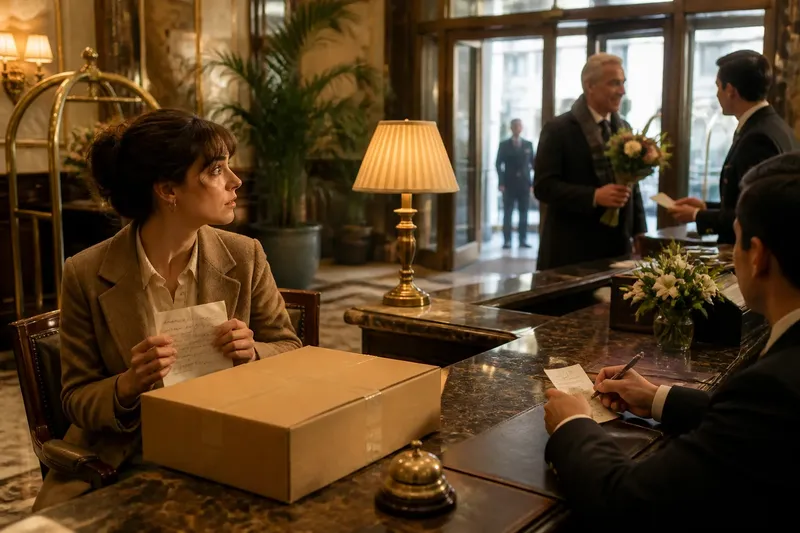
To see that craft clearly, follow one invented film scene from its first image to its final beat. Imagine a carefully dressed hotel lobby, a nervous guest, and a brass bell on the front desk. The scene begins like a familiar mix-up and ends somewhere more human. Nothing in this example comes from a real film; it is a small model for noticing how comic storytelling works.
What expectation does the opening invite?
The guest, Mara, has arrived at a hotel to meet a famous conductor. She has rehearsed a greeting, holds a handwritten note, and keeps glancing at the entrance. The clerk assumes she is waiting for a delivery driver and asks her to sign for a parcel. Mara, distracted, nods and accepts a large cardboard box.
Already, the scene has offered several possible comic directions. Mara might mistake someone for the conductor; the box might contain something absurd; the clerk might mistake Mara for an employee. The scene does not need to select one immediately. Instead, it gives the audience a useful starting point: a person with a clear purpose is being diverted by a routine misunderstanding.
That gap between purpose and interruption is the setup’s first source of energy. Mara wants a dignified meeting. The hotel’s ordinary business keeps handing her practical distractions. The audience can anticipate trouble without knowing precisely what shape it will take.
Comedic expectation is not a promise that a particular gag must occur. It is closer to a path laid across a room: you begin walking in one direction, while the scene leaves room for a turn. The longer the scene makes that path feel natural, the more meaningful a redirection can be.
How does repetition make the pattern legible?
Mara puts the box beside her chair and practices her greeting under her breath. The brass bell rings. She jumps, assumes the conductor has arrived, and straightens her jacket. Instead, a guest at the desk asks for an extra towel. The clerk leaves to find one, and Mara is left guarding the parcel.
Later, the bell rings again. Mara rises with her greeting ready, but the sound comes from a phone notification. She sits back down, embarrassed. The two moments are alike enough to establish a rhythm: a cue suggests the meeting is beginning, then something mundane takes its place.
Repetition gives viewers a chance to learn the scene’s local rules. A bell rings; Mara reacts; reality disappoints her. The next ring now carries extra meaning, because the audience remembers what happened before. But repetition alone is not the joke’s whole design. If each ring produced the same reaction and the same result, the scene would soon feel mechanical.
The details matter, too. The bell is not merely a sound effect; it becomes a signal Mara has chosen to trust. Her quick rise, then reluctant return to the chair, lets the audience read her hopes before she says anything. The scene builds its rhythm through action as well as dialogue.
Where does the scene redirect attention?
Imagine the clerk returns and tells Mara that the conductor has called from the train station. Mara is asked to take the parcel to a side office, where a courier can collect it. She has been waiting for a person, but now the scene gives her a task and a box. For a moment, the likely joke seems to be that she will carry the wrong parcel into the meeting.
Then the bell rings a third time. Mara does not leap up. She has learned to distrust it. This time, the conductor is standing at the entrance, holding a small bouquet. The clerk recognizes him first and points toward the waiting area. Mara looks up just as the conductor walks past her to greet the clerk.
The redirection is not simply “the opposite happens.” The scene has trained us to watch the bell, then made us look at Mara’s reaction to it. When she no longer reacts, the real arrival can happen unnoticed. The surprise grows from the pattern rather than dropping in from outside it.
There is a second turn in the choice of who receives the greeting. The conductor mistakes the clerk for his contact because the clerk is standing near the desk, holding the parcel slip. Mara’s carefully prepared introduction is still in her hand, but nobody has asked for it. The joke has moved from a bell-based misunderstanding to a social one: the person who looks ready is overlooked, while the person handling ordinary business becomes the apparent host.
Why does the turn feel connected rather than random?
A comic surprise can be startling and still feel arbitrary. What makes this one feel earned is the chain of visible causes: Mara’s anxious focus, the repeated bell, the clerk’s routine work, and the conductor’s mistaken assumption all belong to the same little world. The final confusion grows from the scene’s existing relationships and objects.
One helpful question is: what has the audience been encouraged to watch? At first, it is Mara’s anticipation. Then it is the bell. Finally, it is the gap between her readiness and other people’s attention. The focus shifts, but it does not leave the scene behind.
Another question is: what did the setup make plausible? The scene suggested that Mara might mistake a cue for an arrival, or that the parcel could interfere with her meeting. It did not suggest that the lobby would suddenly flood or that a stranger would begin singing opera. Those could be comic events in another story, but here they would lack a connection to the expectation being built.
This is why a punchline often feels stronger when it changes the meaning of an earlier detail. The bell first seems like a reliable announcement. After the repeated false alarms, it becomes a trap for both Mara and the audience. Once she ignores it, the silence of her response becomes part of the joke.
What can the performances and pauses add?
The written events alone do not settle how funny the scene feels. Mara might react with large, showy embarrassment, or with a tight smile and a careful adjustment of her jacket. The clerk might be oblivious, gently amused, or so busy with the parcel that the conductor’s mistake seems entirely understandable.
Small choices can make the expectation more legible without explaining it aloud. If Mara begins to rise before she catches herself, viewers see hope interrupting caution. If she waits a beat before picking up the box, the pause gives the audience time to notice that she has accepted the wrong task. The timing is not a universal formula; it depends on what the scene has taught us to expect.
Editing can shape that timing as well. A cut to the entrance before the bell rings may encourage us to look for the conductor. Holding on Mara as the bell sounds can make her reaction the central event. A cut to the clerk’s parcel slip at the moment of the mistaken greeting might reveal the cause before Mara catches on, giving the audience the pleasure of knowing slightly more than she does.
Sound and image can also disagree in useful ways. The bell may ring clearly while Mara stays still, or the conductor may appear in the background while the foreground remains busy with the box. The audience’s attention is guided through what it hears, sees, and has learned to notice—not through dialogue alone.
How can you spot the turn without turning the joke into a formula?
Try describing the scene in plain language, but keep the description close to its particular details. In this imagined lobby, the expectation is not merely “a surprise is coming.” It is that Mara will keep mistaking ordinary cues for the arrival she wants. The turn comes when she stops responding to the cue, while the real arrival slips past her in a different way.
That description helps reveal the construction, but it should not replace the experience. A joke is also a matter of pace, emphasis, and feeling. If you label every beat as setup or payoff while watching, you may miss the awkward pause or the performer’s restrained expression that gives the moment its texture.
A simple way to examine a comic scene afterward is to ask:
- What does the character want before the joke turns?
- Which detail first points the audience toward a likely outcome?
- What repeated cue or behavior teaches the scene’s pattern?
- At what moment does attention shift to a different detail?
- Does the ending grow from the scene’s people and objects, or arrive without preparation?
These are prompts, not boxes every joke must tick. Some scenes build expectation through a single pause; others depend on a character’s confidence, a visual arrangement, or a line whose meaning changes after the response. The useful habit is to notice what the scene asks you to anticipate and how it changes that anticipation.
What questions help when a joke feels flat?
Does a joke need a repeated cue to work?
No. A single action can establish an expectation if the situation makes its likely consequence clear. Repetition is one way to teach the audience a pattern, not a requirement for comic effect.
Is every punchline a reversal?
No. A punchline may intensify an existing idea, reveal a character’s misunderstanding, or shift attention to a detail that was present all along. The important point is that the ending changes how the preceding moment feels.
Can a viewer spot the turn before the character does?
Yes, and that can create a different kind of pleasure. The audience may see the parcel slip, recognize the conductor, or notice Mara’s missed cue before she does, then wait for the character to catch up.
What if the surprise feels random?
Look back for a connection between the ending and the scene’s earlier actions, objects, or assumptions. If you cannot find one, the surprise may be detached from the expectation; if you can, a second viewing may make the setup more visible.
What does the invented lobby scene leave us noticing?
Mara’s lobby encounter began with an ordinary mismatch: she wanted a meeting, while the hotel kept asking her to deal with its everyday business. The bell turned that mismatch into a pattern, and the pattern made her decision to ignore it matter. When the conductor finally appeared, the scene redirected the expectation through a mistake already supported by its setting and characters.
When you watch another comedy, try tracking one object or gesture that seems to gather meaning as the scene goes on. A ringing bell, a folded note, or a character’s half-finished smile can quietly steer attention. In a well-shaped comic moment, the punchline does not erase the setup; it lets you see what the setup was pointing toward from a fresh angle.