Before the Close-Up: A Short History of the Film Close Shot
The film close shot turns a face or object into a story clue. Follow its changing role from early cinema to modern storytelling and learn to read the frame.

A wrench fills the frame in D. W. Griffith’s The Lonedale Operator (1911), giving a small object a large part in the film’s suspense. That film close shot is a useful place to begin: it shows how a change in framing can direct attention, while the surrounding action supplies the meaning.
What does a film close shot make visible?
A close shot brings a face, hand, or object forward until it becomes the main event in the image. The term covers several degrees of closeness, from a face framed tightly to an extreme detail such as an eye or a fingertip. There is no single boundary that every film follows.
Closeness can make expression easier to see, but it does not dictate a feeling. A face might seem tender, guarded, or threatening. A key might look like a routine prop in one scene and a source of suspense in another.
The frame also hides things. A close shot may exclude the room, other characters, or the source of a sound. It is like holding a small note near your eyes: the writing gets clearer, but the table around it disappears.
How did close framing develop in early cinema?
Early narrative films often arranged performers in broad compositions that made the action legible as a whole. But cinema did not begin with one fixed distance and then steadily move closer. Filmmakers experimented with shot scale from the medium’s early years, and close views gradually became part of a more flexible visual vocabulary.
The Lonedale Operator offers a clear example of close framing serving plot. A wrench is mistaken for a revolver, and the close view helps the audience register the object at the center of that misunderstanding. The tool matters not because it is inherently dramatic, but because the scene has established the danger surrounding it.
In the 1920s, Soviet filmmakers such as Sergei Eisenstein made the relationship between shots especially prominent. In Battleship Potemkin (1925), meaning and emotional force emerge through the arrangement and contrast of images. That editing tradition reinforces a useful point: a close shot does not work alone. Its effect changes according to the image before it and the image that follows.
How did close shots become a familiar storytelling tool?
As film grammar developed, audiences encountered close views across different kinds of stories. A thriller could use one to make a clue or threat legible; a drama could stay near a performer’s reaction; a comedy could isolate a small gesture that changes the joke. These uses did not erase the close shot’s ambiguity. They made changes in scale familiar signals that the viewer should attend to something in particular.
That familiarity is part of the close shot’s history. A close view can provide practical information, but it can also hold back an explanation. The same framing choice may clarify what a character sees while leaving us unsure what that character feels.
Why can a close-up feel tender or unsettling?
Close framing makes small shifts in performance easier to notice: a pause, a glance toward the edge of the frame, or a smile that fades. Such details can suggest conflict without spelling it out. They remain signs to interpret, not a direct window into a character’s thoughts.
Duration matters, too. A brief close shot may register a reaction and move on. A longer one can make the viewer wait for a change, or notice that no change comes. Instead of simply adding emotion, the extra time can create scrutiny or uncertainty.
What changes when the close shot shows an object?
An object becomes significant through its place in the scene. A glass, letter, or door latch may be ordinary in itself; framing gives it emphasis, while the story teaches us what to expect from it.
Say Mara, in an invented scene, finds a folded note beside her coffee cup. She reads its first line, turns away, and leaves it unopened. The film cuts from her uneasy glance to the note, then back to her motionless hand. The note now feels like an unresolved question. If the scene remained wide, the hesitation could be harder to distinguish among all the activity around the table.
Sound can add pressure without changing the object. A close view of a hand on a doorknob feels different if footsteps approach from outside the frame. The image gives us the hand; sound makes us attend to what we cannot see.
How can you read a film close shot in context?
Rather than treating a close shot as a self-contained clue, connect it to the scene around it. Notice what prompted the change in framing, what the crop removes, and how the next shot affects your first impression.
- Observe the event just before the close shot. If a character discovers something or hears a new sound, then read the framing as a possible response to that event; otherwise, look for a gesture or detail the film may be emphasizing.
- Observe what disappears from the frame. If the room or another character drops out, then consider whether the subject is isolated; otherwise, compare the close view with the visible surroundings for a different source of meaning.
- Observe the performer’s gaze. If the character looks toward someone offscreen, then consider how that unseen person shapes the moment; otherwise, attend to the character’s expression and stillness without assuming a hidden addressee.
- Observe how long the shot holds. If it lasts through a pause, then notice whether the pause builds expectation or refuses an answer; otherwise, consider whether the quick cut simply registers a reaction.
- Observe the sound beyond the image. If a noise has no visible source, then treat it as part of the scene’s tension or information; otherwise, let the framing and visible action carry your reading.
- Observe the shot that follows. If the film returns to the room, then use that wider view to revise your interpretation; otherwise, if it stays close or shifts to another detail, consider what the film continues to withhold.
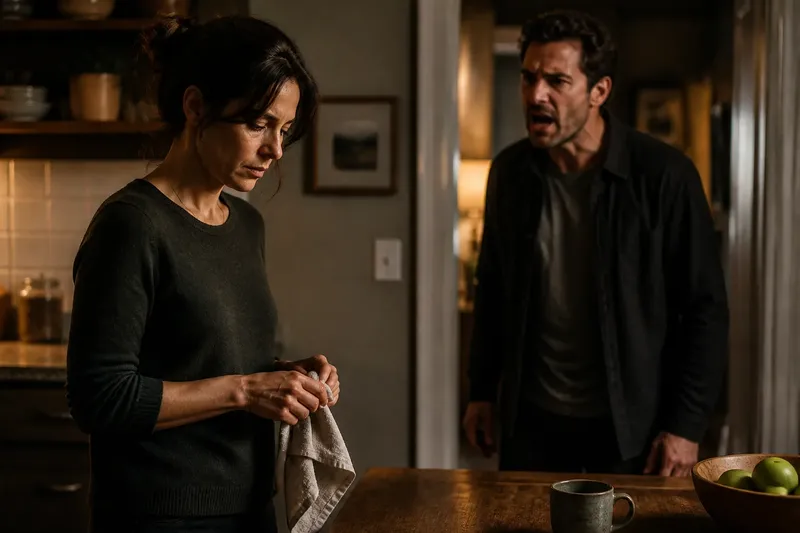
Imagine an invented scene in which Lena hears a latch click while standing in a kitchen. The film cuts to a close view of her hand gripping a mug, then holds as she looks toward the hallway; a faint footstep follows. First, the latch supplies the cue for the closer framing. Next, the cropped image hides the hallway, while Lena’s gaze points toward it. The sound makes the unseen space feel relevant, and the held shot keeps her reaction in view. If the next shot reveals an empty hallway, the viewer can read her grip as fear or misjudgment; if the film stays on her face, the cause remains uncertain. The close shot directs attention, but the surrounding choices determine what can reasonably be inferred.
When can a close shot say more by showing less?
A close shot may withhold the clue we expect. A hand can stop short of an object, or a face can remain still after a question. The viewer is invited to look closely without being handed a definite explanation.
Framing can also give one character more visual weight than another. If one person fills the screen while someone else remains distant or offscreen, the image may align us with the nearer character. It can also prompt us to question why that viewpoint has been favored.
The film close shot’s history is not a simple story of cameras moving ever closer. It is a history of filmmakers using scale and editing to shape attention, make details legible, and preserve uncertainty. When a close view appears, the surrounding shots remain part of its meaning: they tell you what the detail connects to, and what the film has chosen to leave outside the frame.